AI Product Developer
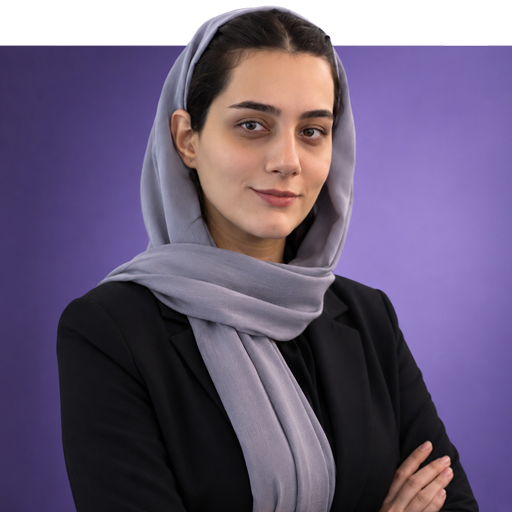
Nahid Abdollahi
MSc Artificial Intelligence
Building products at the intersection of machine learning, natural language, and real-world impact. From prompt engineering research to production ML systems.
Building products at the intersection of machine learning, natural language, and real-world impact. From prompt engineering research to production ML systems.
I'm an AI engineer and researcher who builds systems that work beyond the lab. My path has taken me from Android development to designing production knowledge-graph pipelines used by domain experts — and every step has sharpened my core belief: the best AI is the kind that is efficient, reliable, and practically deployable.
At IREX, I built a full document-intelligence system: raw PDFs processed through OCR, spaCy, coreference resolution, and NER, feeding a knowledge graph that lets geologists query complex structured data in plain language. I chose to fine-tune a smaller RoBERTa model for NER rather than depend on hallucination-prone LLMs — a decision that reflects my engineering philosophy.
In parallel, my academic work on automated prompt engineering led to a published paper at ICAART 2026, introducing DPPROMPT — a method that finds high-performing prompts with significantly fewer LLM calls than prior art.
Leading development of a Relation Extraction model for automated knowledge graph construction. Combining fine-tuned NER (RoBERTa) with rule-based relation extraction to produce structured, queryable graphs from unstructured geological documents — deliberately avoiding LLMs in the extraction layer to eliminate hallucination risk.
Developed a customized HR intelligence chatbot that transforms structured human resources data into a graph-based knowledge system. Implemented graph data modeling and LLM-driven querying to answer technical, statistical, and organizational questions about employees, departments, and company structure.
Redesigned the document intelligence pipeline to scale. Migrated from Neo4j to Cassandra + JanusGraph for performance. Built the full NLP pipeline end-to-end: PDF ingestion → OCR → spaCy text cleaning → coreference resolution → sentence/chunk splitting → knowledge graph construction.
Built a customized AI shopping assistant capable of understanding customer intent through interactive question-driven conversations. The system reads online-shop product databases, infers the user's underlying needs, and recommends the most suitable products using semantic retrieval and LLM-based reasoning.
Built the first MVP of the document intelligence system — a RAG-based chatbot processing 100+ PDFs into a Neo4j graph database using LangChain and SBERT embeddings.
First professional AI role. Gained hands-on experience with LLM application development, prompt engineering, and LangChain-based pipelines.
Developed a computer vision system for agricultural disease detection using a fine-tuned YOLOv5 CNN model. The model analyzes pistachio tree leaf images to determine whether the tree is infected and classifies the specific parasite or illness type. Built and optimized the training pipeline for real-world image conditions and dataset variability.
Game and simulation development in Unity with C#. Built the systematic thinking and software architecture skills that now underpin my AI engineering work.
Mobile application development for Android. First professional software engineering role.
A full-stack expert knowledge system that transforms unstructured geological PDFs into a queryable knowledge graph. Key engineering decision: used a fine-tuned RoBERTa model for NER rather than LLMs, eliminating hallucination in the extraction layer entirely.
GitHubA novel prompt optimization algorithm using DPPs as a local search strategy to select diverse, high-quality prompts — achieving PromptBreeder-level performance with dramatically fewer LLM calls. Evaluated on 10 benchmarks across Mistral, Llama, and Qwen.
Extends DPPROMPT by generating a "reflection wait" prompt that enforces deeper chain-of-thought reasoning in smaller models — closing the gap between compact LLMs and full reasoning-scale models without fine-tuning.
An alternative to DPPROMPT integrating Maximal Marginal Relevance with Simulated Annealing — balancing diversity and similarity in prompt space exploration.
Conversational shopping assistant combining FAISS vector search, Elasticsearch keyword search, and SBERT embeddings for hybrid retrieval — ensuring both semantic and exact-match relevance.
Large language model performance depends heavily on effective prompt engineering. While methods like PromptBreeder introduced self-referential evolution of prompts via genetic algorithms, they introduce significant computational overhead. DPPROMPT addresses this using Determinantal Point Processes as a local search strategy to select diverse, high-quality prompts — balancing performance and diversity without complex self-referential mechanisms. Evaluated on ten benchmarks including GSM8K, MATH500, GPQA, MultiArith, and CSQA using Mistral, Llama, and Qwen, DPPROMPT achieves results comparable to PromptBreeder while significantly reducing computational requirements.
A complete survey and experimental study of prompt engineering — from hand-crafted methods (Plan-and-Solve, Chain-of-Thought) to fully automated systems. Includes a working implementation of DeepMind's PromptBreeder and introduces two original optimization approaches: DPPROMPT and MMR+SA.
A revised exploration of our previous prompt optimization approach combining Simulated Annealing with Maximal Marginal Relevance (MMR), focusing on improving local search stability and maintaining diversity in prompt candidate selection.
A research direction on augmenting instruction prompts with structured self-reflection signals to improve reasoning quality in smaller language models. The goal is to reduce the performance gap between compact models and large-scale LLMs without fine-tuning.
I'm open to international AI product roles, research collaborations, and interesting problems. If you're working on something at the frontier of intelligent systems, reach out.